Friday, 22 May 2015

Turtle Week Updates

The third day of Turtle Week had our staff our conducting a reef check around Pulau Mabul. Reef checks are a crucial part of reef conservation, providing us with an idea of the health of our coral reefs. Reef checked trained divers lay a 100m transect line. Within this line they gather information on fish, invertebrates and substrates. There are certain indicator species that provide a picture of the health of the reef and we can gain an understanding of whether our reefs are declining or improving. Of course, as divers and snorkellers we are invested in maintaining the health of our coral reefs. Having a better understanding of the state of our reefs can be hugely beneficial to maintaining a balanced ecosystem. 

The evening brought a fascinating presentation from Scott Mayback who talked about the turtle rehabilitation work he does on Gaya Island just off Kota Kinabalu. It was inspiring to hear about the turtles that he has helped nurse back to health. There are many things that affect the health of sea turtles, with plastic of course being a large concern. A large part of a green turtles diet is jellyfish and sadly turtles will mistake plastic bags for food. As turtles are unable to digest plastic it will start to build up in the system.  This, as you can imagine, causes huge problems for turtles, and is one of the many reasons Scuba Junkie places such an emphasis on reef and beach cleans. We at Scuba Junkie paid particularly close attention to the fascinating information provided in Scott's presentation, as his expertise will help us massively with regard to our own Turtle Rehabilitation centre. This centre will have its grand opening later this week, and we will be relying on the experience of people like Scott to ensure its success.


This week we have also conducted a pub quiz. The night was hugely successful and we raised over 500RM for Turtle Conservation. Our Environmental Officer - Dave - was our quizmaster for the evening and had composed a quiz filled with turtle trivia. Our top prize was a turtle adoption and turtle hatchery t-shirt, second prize was a Dive Against Debris reef clean goody bag and third place earned a goody bag kindly donated by WWF. It was great to see everyone getting involved and coming together to raise money for our beloved turtles. And a huge congratulations to our winning teams!


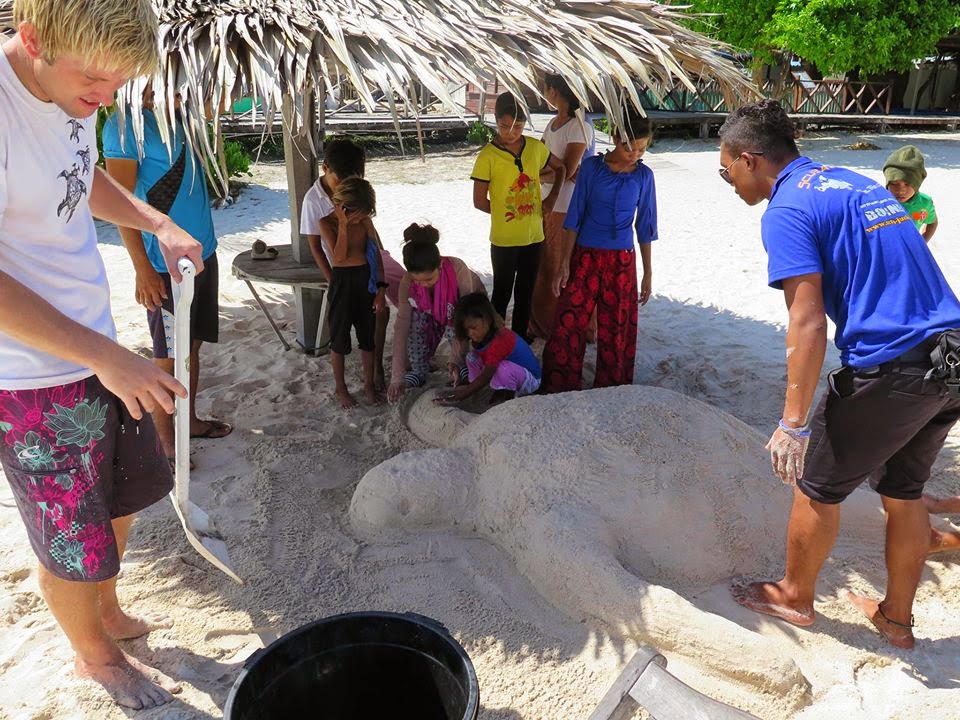
Later on in the week we held workshops with the local Bajau children. One of our local dive-masters, Afat, assisted in translating for the rest of our staff during the activities we had organised for them. He was also hugely helpful in explaining to the local community the importance of turtles in this area. The ability to reach out to the younger generations on Pulau Mabul is something we place a lot of emphasis on. This is an an area in which we see a real opportunity to make some serious changes in attitudes towards recycling and pollution. We were therefore of course incredibly grateful for the children who came along and got stuck in, and hopeful that they will have taken at least a small part of the message home with them. 


Also this week, Scuba Junkie saw staff, interns and guests getting involved in another massive beach clean. We collected a huge amount of rubbish from our shore which will be transported from the island later this week. As previously mentioned Scuba Junkie are huge advocates for beach cleans. Although they may not be the most glamorous part of conservation work, their effect is immediate. Every bag you remove during a beach clean is one less bag that a turtle may try to eat.  We are hugely appreciative of everyone who came and got stuck in and showed their support. 


Last night we had Aaron 'Bertie' Gekoski give a lively presentation on how social media can play a part in spreading the conservation message. Aarron is a journalist and presenter who has worked in some fascinating places. He has been witness to some devastating events and shared some of these with us. From filming the massacre of hundreds of thousands of turtles as part of a religious festival in Bangladesh, to filming starving elephants in Zimbabwe there is no doubt that Aaron has been involved in documenting some horrific things happening world wide. What Aaron explained to us was how far reaching social media truly is, and that we should be using this to spread the message of conservation. The saying that 'a picture is worth a thousand words' seems apt for what he discussed. With the likes of Facebook, Twitter and YouTube becoming more and more influential we are able to inform others of what we are fighting for. 


Tuesday, 19 May 2015

Turtle Week: Day Two


 After the crazy first day of Turtle Week, the second day was a little calmer. The heavy rain that we experienced on the opening day meant that not all of the local children who wanted to get involved in our beach clean could participate. However, we witnessed an inspiring sight when all those who could not get involved in our first beach clean turned up wanting to try again. Occasions such as this show us that, in conjunction with the local community, we are capable of making a real difference to the beaches of our island.


The rest of the day involved a lot of underwater action. The day begun with our staff developing our coral transplant programme. They took a boat around Pulau Mabul and collected fragments of coral. These fragments were then relocated to our coral nursery. Our aim is to create an environment in which corals can develop easily and without harm. Not only is this beneficial to the coral, but also to the many other marine species that rely upon the coral to survive.
After this we had staff and some enthusiastic customers get involved in a reef clean. We are huge advocates of reef cleans here at Scuba Junkie, and to see guests give up their fun diving days to take part was incredible and we are truly grateful to all those who were involved. Reef cleans are so important to the health of our reef and the presentation given by Dave on our first night provided an insight into their importance. We look forward to more people joining us on these dives, especially on our upcoming continuous reef clean which will be taking place towards the end of this year’s Turtle Week.
In the evening we had another captivating presentation from Environmental Officer Dave McCann. This time he talked about the biology of various species of turtles, especially those that frequent the waters of Malaysia. We are lucky enough to regularly see Green and Hawkbill turtle around Mabul, Kapalai and Sipadan. However, these are listed as ‘Endangered’ and ‘Criticallly  Endangered’ respectively on the IUCN Red List. This fact is the driving force for us at Scuba Junkie in terms of why we place so much emphasis on our conservation programmes. We were given fascinating information about these species of turtles and informed of the awful threats that they face.

The success of the first few days of Turtle Week has been impressive to say the least, and we can’t wait for them rest of the week’s amazing activities. From reef checks and cleans to presentations and completions, we’re confident the action packed and fun filled week will continue in spectacular fashion!


Monday, 18 May 2015

Turtle Week: The Opening Ceremony

After weeks of anticipation and preparation, Turtle Week finally got underway today in spectacular fashion!

The morning brought the arrival of the school children from the SK Mabul, as well as the children from Project Sha, a community based programme on Pulau Mabul. They arrived bright and early at the Scuba Junkie resort, and things got off to a fun start with some games on the beach as we awaited the arrival of Green Semporna. Green Semporna are a volunteer group who are dedicated to getting involved in conservation activities and are committed to environmental protection. 


On the beach, the games were brought to an abrupt end as the heavens opened. However, the kids did not let the rain dampen their spirits, as it merely meant a change of venue and the games could continue! Inside the warm and comfort of the resort, our staff members along with Green Semporna began with some colouring in and decorating the walls with some amazing turtle pictures! This was then followed up with a two presentations from Green Semporna, which covered everything from turtle biology to feeding and mating habits. 


At lunch time one of our Resort Managers - Steve - performed the Opening Ceremony. He provided us with an informative overview of the upcoming week and the activities we could expect. He also talked about the importance of turtle conservation and what the week is aiming to promote.

After these hugely informative talks, the children once again got stuck into some games - there was no tiring these guys out! It seemed like everyone enjoyed the day. The days activities were rounded off with Green Semporna heading out for a snorkel off of the Scuba Junkie Jetty - one of the best places for turtle spotting around the whole island!! 

One of our Environmental Officers, Dave McCann, gave an extremely informative presentation on Marine Debris. We were given some devastating facts. Reports have shown that 280 million tonnes of plastic are produced in just one year and alarmingly 20 million tonnes of this ends up in the Oceans. This is just one of many pieces of information that we were presented with and there is no doubt that many in the room were shocked by the reality of the Marine Debris situation. However, as Dave said, it is not all doom and gloom. There are people making a change and trying to rectify this situation. 


Here at Scuba Junkie we perform regular beach and reef cleans and try to make as little of an impact on the environment as possible. Beach and reef cleans are key and something that everyone can get involved in. They require little training or experience and have an immediate effect. Green Fins - a non-profit organisation that asses dive and snorkel centres on their impact on the environment - voted us number 3 out of the dive centres that they have assessed across South East Asia. 


There is no doubt that the start of this years Turtle Week was a huge success! We can’t wait to see what the rest of this exciting time brings. 


Sunday, 3 May 2015

A day in the life of an Instructor

With our upcoming IDC we thought it would be a great time to take you through the day in the life of a PADI Certified Instructor on the beautiful island of Mabul. 

As a PADI Dive Instructor you are able to teach a range of courses, from taking people on their first ever Discover Scuba Dive, to training and mentoring future PADI Divemasters. These courses will challenge and test you in a range of ways, as well as expanding your skills in ways you couldn't imagine. 

But let's start at the beginning - a PADI Discover Scuba Diving (DSD) experience. 

The DSD programme allows those who are not sure if they want to commit to the Open Water course to try diving. It requires no classroom time and can be done in just one morning. The customer is provided with basic diving theory to ensure they remain safe whilst underwater. 

The day starts at 8.30am. Staff and interns alike come together to set up the jetty for the days diving. Tanks are collected from our compressor room, and BCDs and regulators are brought out from the equipment room. The energy on the jetty in the morning is infectious, everyone is excited about the upcoming day of diving. As dive professionals we love to share our passion with other divers, and that's what these days are about. 

There is no classroom time for the DSD, so customers are met on the jetty. From there we take them to our shaded briefing area - the sun can be unforgiving at times! Away from the hustle of the jetty you are able to discuss with your students their feelings about their first ever dive. Whilst some may be fearless, more often than not there are some apprehensions. Taking your first breaths underwater can be a nerve racking experience - doing something that your body has been told for its entire life that it cannot do! As an instructor - someone who is borderline growing gills - we have to learn to understand this feeling.

In the DSD briefing, our students are given an introduction to the physics of diving and what happens to our bodies, as well as information on how to be a safe diver. There is the delicate balance of making someone feel safe, but ensuring they understand that there are some serious risks involved in diving. Once the safety briefing is complete you then take them through some of the basic diving skills. Having them complete a regulator clearing skill, regulator recovery and a mask clearing skill means they are equipped to deal with the minor discomforts that divers can face in the water. To instructors these dive skills may seem simple, but for people who have rarely spent time in the water it can be a challenge. Helping people overcome there fears and difficulties that they face during these experience is one of the most rewarding aspects of being an Instructor. 

Once the skills are completed it's time to take people on their first dive! This is a fantastic experience for all those involved. Showing people their first turtles, their first schools of stunning colourful fish makes and their expressions as you do so is one of the greatest parts of teaching. Keeping your student close and ensuring they feel safe is imperative. But of course this is a joyful experience, a day that people will treasure. 

Showing people their first turtle is amazing!!
The DSD experience is two dives, the first is done on our House Reef. Swimming over sand around sunken boats and large structures that have attracted a plethora of life. Huge turtles sit surrounded by schools of blue striped snapper. Angelfish and butterfly fish flash their colours as they weave in-between the structures. Eels poke their heads out from underneath tyres. There is an endless amount of things to see. On the second dive we take our Discover Scuba Divers on a coral reef dive. Froggies is a shallow reef this sits to the West of our jetty. Along here we see huge schools of two spot snapper, beautiful corals, turtles, octopus and cuttlefish, amongst many other things! 

After two dives everyone is ready for lunch. This is a chance to discuss with these new divers how they feel about the diving day and explain to them the beautiful things that they saw. After lunch divers are given the chance to go for a third dive. Sometimes they even get to go out on one our our boats. After the last dive its time for the equipment break down. The customers go off to the beach to relax whilst staff and interns wash gear and clears tanks from the boats. Everyone works as a team and it's takes less than 30 minutes. It gives staff a chance to discuss their day and speak to the other customers who are still milling around the jetty soaking up the buzzing atmosphere. 

Once the busy day is done it's time to head up to the lovely Scuba Junkie bar. An ice cold beer shared with your divers is a great way to finish the day. Everyone comes together to discuss the days diving, the intriguing fish that they saw and the rewarding experiences they have had with their divers. 

The range of people who you experience whilst working as a PADI Open Water Scuba Instructors is truly unbelievable at times. Watching people overcome their fears face on and the challenges they overcome is a rewarding experience. 

We are a passionate bunch who love to meet new people. Doing the Instructor Development Course at Scuba Junkie means you are surrounded by experienced instructors who love to share their knowledge with you. 


For more information send us an email: info@scuba-junkie.com. We hope to see you soon! 

Don't forget to follow us on twitter! @ScubaJunkie_MY

Thursday, 26 March 2015

Stunning Visibility and Record Breaking Turtle Nests!


It’s been a beautiful month on Pulau Mabul – both in and out of the water. The sun has been shining and the conditions underwater have been mind-blowing. Turtles have been nesting and hatching, Hammerheads have been showing their bizarre looking faces at Pulau Sipadan and Wonderpus have been creeping around Mabul. It’s been the perfect time for our special guest, who has been recording many of these incredible events, to be here. 


Aaron and his famous 'Shark Selfie'
Aaron ‘Bertie’ Gekoski is a professional dive journalist who has had documented some amazing experiences. We are fortunate to have him here on the island, working with Scubazoo on an exciting new project which we will be revealing more about in the upcoming months. He has been talking to our staff about our various conservation projects, filming some beautiful underwater critters and also getting involved in our bustling on-land activity. There are always exciting things happening around Scuba Junkie and we are looking forward to working with him on documenting these events. For more information on Aaron and Scubazoo, check out their websites: www.aarongekoski.com and http://www.scubazoo.com/


School of Big Eyed Trevally at Sipadan
Pulau Sipadan has been stunning divers for the past few weeks. With visibility reaching an incredible 50m on many days, our divers have been blown away by the topography of this unique island. When discussing Sipadan it is often the sharks, turtles and schools of fish that are the hot topic of conversation. However, this incredible visibility has meant that even our most experienced Sipdan guides are seeing parts of the majestic wall that they have never seen before. Also the magical beauty of the healthy corals up in the shallow has really been shining through.

One of the things that make Sipadan such an incredible place to dive is its geology. The island is an oceanic volcanic seamount and is the only one like it in Malaysian waters that breaches the surface. The water surrounding this island is extremely deep. On the north side of Sipadan the waters reach depths of 600, whilst on the south point of the island the depth is an almost intimidating 2000m. To put this into a little perspective, the maximum depth around Pulau Mabul and Kapalai is 40-60m. 


Even when the visibility is closer to 20m, it is easy to feel dwarfed by this stunning wall. With the visibility being as crystal clear as it has been of late, many of our divers have remarked on how  humbling an experience it has been to realise how small they are in this vast ocean. 

The incredible wall at Sipadan dwarfs divers

But let’s not forget about the fish. Scalloped hammerheads have been seen several times this month. In just one day one group were lucky enough to see 7 of these majestic and mystical sharks. The beautiful blue water means that the schooling fish have been a delight to see. The huge schools of chevron barracuda and the big eyed trevally amazed divers. The sheer volume of these fish is almost unbelievable, and the 50 metre visibility has only aided our divers in their appreciation of these amazing schools.

Wonderpus - thanks for the photo Fred!
But let us not forget the other islands that have been keeping us more than entertained underwater. We have recently had an encounter with the elusive wonderpus. This shy cephalopod is seen along sandy bottoms and is the treasure of many divers. A much sought after find for photographers due to the bizarre and wonderful ways they pose.  

Turtle Eggs - photo by Aaron Gekoski
 Out of the water has also been a delight - we have had turtles both nesting and hatching on Pulau Mabul! Not only that but we have had two record breaking nests! This had led to a very busy hatchery these last couple of weeks. On the 16th February we had our largest nest since the hatchery opened 4 years ago – 170 eggs from a green turtle. Then one month later this record was broken. A hawksbill turtle laid an amazing 172 eggs! We can’t wait for these little hatchlings to burrow their way up from their nests and begin their journey to the vast ocean. Our Turtle Adoption Scheme has been running for nearly a year now, and has been a huge success. If you are interested in adopting a Turtle then please do not hesitate to get in touch: info@scuba-junkie.com


Mabul Beach Resort Manager Steve giving one of our local rangers their reward.


Thursday, 12 February 2015

Shark Conservation with Scuba Junkie and Shark Stewards


Shark conservation, the heart of our SEAS conservation work, has been given a special boost this month. As well as amazing sightings of scalloped hammerheads, large grey reefs and numerous white tip reef sharks at Pulau Sipadan, we are lucky to receive a visit from the Director of Shark Stewards, David McGuire.  Shark Stewards is an American based NGO that was set up by David himself. Their focus is to restore ocean health by protecting apex predators such as sharks. Their aim is to protect critical marine habitat through the establishment of Marin Protected Areas. They are an inspiring organisation that has achieved a great amount. His visit has really brought to mind how lucky we are with so many shark sightings at Sipadan – as over a third of all shark species are threatened with extinction in the near future. We sat down with David McGuire and talked about what sparked his interest in shark conservation, the threats sharks face and what everyone and anyone can do to help


Why Protect Sharks?
This is a question that many of us will have either wondered or been asked. The movie ‘ Jaws’ created huge hysteria around this stunning creature, with people too scared to even get into the ocean. Sharks were portrayed as a monster, as a man-killing machine that needs to be destroyed. This is a perception that has been difficult to change with many people. But those who have dived with sharks will understand that they are beautiful, curious, but often shy creatures. With fear so hugely associated with sharks, many do not understand why there is a need to protect them.

The underwater world is in a state of delicate balance. Sharks are the apex predators in this ecosystem they have no natural predators. A healthy reef system needs to be managed and it is the sharks, at the top of the food chain, that do this. As the top predator, they regulate the populations of predator fish directly beneath them in the food chain – who in turn prey on fish that eat algae. Without sharks regulating the population of the predator fish, the numbers of fish that control the algae population will decrease. Consequently algae will begin to blanket the reef, smothering it. The result of this will be devastating and the underwater ecosystem will fall apart.

David McGuire during his presentation on Pulau Mabul
It was David’s own observations of this in 2003 that brought him into shark conservation. Whilst on a diving and sailing trip in French Polynesia he noticed there was a marked difference in the structure of the reefs that had sharks and those that didn’t the reefs with the higher shark population being the healthiest. Any of our divers who have dived at Pulau Sipadan will have also noticed this. He was also curious to see that there was such a big difference in shark populations around these islands. It was here that he learnt of the devastating shark fin trade, and was unfortunate enough to witness sharks that had their fins cut off being dumped, alive, in the water.

But it is not only the health of the reef that we must consider when determining the importance of sharks.  The economic value of a live shark is so much greater than that of a dead one. During his presentation, David McGuire showed a short film about the Semporna Shark Sanctuary, produced by ScubaZoo. This powerful video explains that a live shark is worth over US$800,000 over its lifetime in terms of eco-tourism, whereas a dead one is sold for just US$100. The growing eco-tourism industry in Semporna is worth far more than many people may realise.
To see this incredible video just follow this link: 

https://www.youtube.com/watch?v=cIdW2A_6gnk

Whale Sharks: One of the many species of shark seen in the proposed Semporna Shark Sanctuary


The Threats Sharks Face:
Although Sharks have been portrayed at man-eating beasts, this is far from the truth. As the apex predators sharks have no natural predators, so the only reason for their decline in population is, sadly, us. We have become too good at what we do. 

                Over Fishing is huge threat faces the underwater world. Boats will place down massive nets   either  purse seine nets, or nets that drag over the ocean floor. There is no discrimination in what these nets catch, meaning sharks, rays and turtles will be dragged along, as well as thousands of fish that are not the target species of the fishermen. By the time the net is pulled to the surface these creatures are often dead. Some of these are just dumped overboard – a wasteful practice known as ‘bycatch’.  Such unsustainable fishing practices are the reason why we do not serve seafood at Scuba Junkie.

                Long-lining is, unfortunately, a widely used fishing practice. Miles of baited hooks on long lines will be left in the ocean. The bait attracts many types of marine life. Sharks will lie trapped on the hooks for hours, with a hook through their mouth unable to escape. Once the sharks are brought onto the boat they are stripped of their fins and cast back into the ocean – still alive.


Shark Fin Soup – The consumption of shark fin soup is possibly the biggest threat facing shark species. Shark fin soup is a Chinese delicacy that represents wealth and prestige. It used to just be a small percentage of the population that was able to consume it, but with a growing economy more and more people are consuming this soup at weddings and other social events. The shark fin provides no flavour for this dish, which actually uses chicken broth as a base. However, many wrongly believe that the fin contains various health benefits. Research has actually shown that consuming shark fin leads to mercury poisoning, and is directly linked with Alzheimer’s disease.
The demand for shark fins for this Chinese delicacy is decimating shark populations across the world. The fin of a shark is worth an incredible amount, and although restrictions have been placed on shark finning in a few places around world, many are taking the risk because of the money they can make.

 Although many are quick to blame the Asian countries for this, countries in Europe and America are actually in the top 10 for supplying shark fin! These problems are right on our doorsteps and there is more that we can be doing than you may realise. 


Semporna Shark Sanctuary

The designs for the Semporna Shark Sanctuary began in 2009. The idea was to create a protected area for sharks and rays in the east of Sabah, defending them against commercial fishing and finning. The East Sabah area boasts 63 species of shark and 68 species of ray. Situated in the centre of the coral triangle, this is an extraordinarily biodiverse area.
But the Semporna Shark Sanctuary is not just about prevention of shark fishing – it is also about securing the future of the local community by providing sustainable economic alternatives to fishing. With the growth of ecotourism in the area, the proposal aims to provide opportunities for people - new job positions are becoming available; boat captains, divemasters, instructors, housekeeping along with many others. This gives people the chance to provide for themselves and their families without having to fish.
As David mentioned, data is key to the implementation of the Semporna Shark Sanctuary. Over the years our staff has collected information on shark sightings in the proposed Semporna Shark Sanctuary area, and unfortunately there has been a decline. This data demonstrates that creating the Sanctuary is vital. But David’s goals don’t end there, and neither do ours. It is not just the Semporna area that needs protecting, but all of Sabah.  In fact, David discussed how important it in to work in shark conservation in the whole of Malaysia, due to its location in the coral triangle. 

Schooling Scalloped Hammerheads seen at Pulau Sipadan


What you can do: 


David has been an activist in shark conservation for many years now, and so we discussed with him what he thinks people can do to aid this cause. 


Spread the word
It is almost surprising how many people are not even aware of the consumption of shark fin soup, let alone the effect it has on the underwater world. When you learn about these things inform others about it. The more people that know, the more people who can help create change! 

Take a pledge
Don’t eat shark fin soup!! By refusing to eat shark fin soup and refusing to eat in restaurants that sell shark fin products you can help to reduce the demand for shark fins. It may seem like a small thing to do, but every little really does count! Consider not eating seafood, or only eat seafood that you know comes from sustainable sources. 


Support dive centres that are making an effort
As divers we are ambassadors for the underwater world and many dive centres will take this responsibility extremely seriously. When booking your diving holiday do some research, find out which dive centres in the area are making the extra effort. Many dive centres around Asia and the rest of the world will be actively getting involved in helping to create Marine Protected Areas (MPAs) and raising awareness for conservation and environmental work in their area. Donations to organisations such as Shark Stewards, or SEAS, are also extremely beneficial to this important cause.

We extend a huge thanks to David for coming to see us. He gave an extremely interesting presentation and has been discussing the Semporna Shark Sanctuary with our on-site Environmental Officers Dave and Cat. We look forward to working closely with him and others through the Sabah Shark Alliance to implement the Semporna Shark Sanctuary. 

For more information on David McGuire and the incredible work he has done through Shark Stewards  please visit their website: www.sharkstewards.org